Transcription
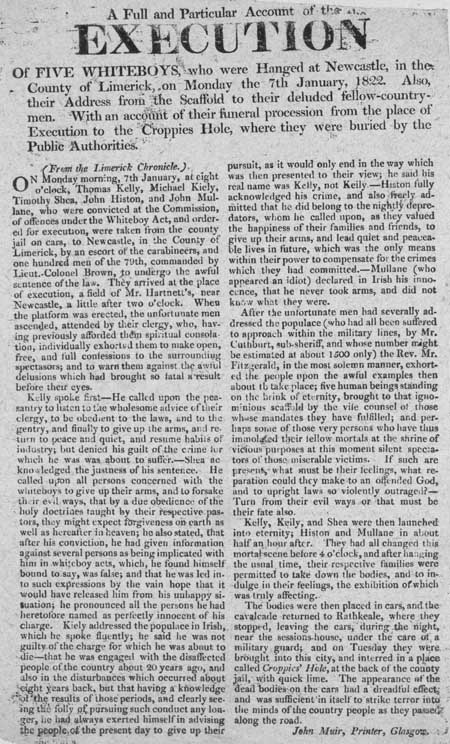
A Full and Particular Account of the EXECUTION Of FIVE WHITEBOYS, who were Hanged at Newcastle, in the County of Limerick,on Monday the 7th January, 1822. Also, their Address from the Scaffold to their deluded fellow-country- men. With an account of their funeral procession from the place of Execution to the Croppies Hole, where they were buried by the Public Authorities. (From the Limerick Chronicle.). ON Monday morning, 7th January, at eight o'clock, Thomas Kelly, Michael Kiely, Timothy Shea, John Histon, and John Mul- lane, who were convicted at the Commission, of offences under the Whiteboy Act, and order- ed for execution, were taken from the county jail on cars, to Newcastle, in the County of Limerick, by an escort of the carabineers, and one hundred men of the 79th, commanded by Lieut.-Colonel Brown, to undergo the awful sentence of the law. They arrived at the place of execution, a field of Mr. Hartnett's, near Newcastle, a little after two o'clock. When the platform was erected, the unfortunate men ascended, attended by their clergy, who, hav- ing previously afforded them spiritual consola- tion, individually exhorted them to make open, free, and full confessions to the surrounding spectasors; and to warn them against the awful delusions which had brought so fatal a result before their eyes. Kelly spoke first—He called upon the pea- santry to listen to the wholesome advice of their clergy, to be obedient to the laws, and to the gentry, and finally to give up the arms, and re- turn to peace and quiet, and resume habits of industry; but denied his guilt pf the crime for which he was was about to suffer.—Shea ac knowledged the justness of his sentence. He called upon all persons concerned with the whiteboys to give up their arms, and to forsake their evil ways, that by a due obedience of the holy doctrines taught by their respective, pas- tors, they might expect forgiveness on earth as well as hereafter in heaven; he also stated, that after his conviction, he had given information against several persons as being implicated with him in whiteboy acts, which, he found himself bound to say, was false; and that he was led in- to such expressions by the vain hope that it would have released him from his unhappy si- tuation; he pronounced all the persons he had heretofore named as perfectly innocent of his charge. Kiely addressed the populace in Irish, which he spoke fluently; he said he was not guilty of the charge for which he was about to die—that he was engaged with the disaffected people of the country about 2O years ago, and also in the disturbances which occurred about eight years back, but that having a knowledge of the results of those periods, and clearly see- ing the folly of pursuing such conduct any lon- ger, he had Always exerted himself in advising the people of the present day to give up their pursuit, as it would only end in the way which was then presented to their view; he said his real name was Kelly, not Keily —Histon fully acknowledged his crime, and also freely ad- mitted that he did belong to the nightly depre- dators, whom he called upon, as they valued the happiness of their families and friends, to give up their arms, and lead quiet and peacea- ble lives in future, which was the only means within their power to compensate for the crimes which they had committed.—Mullane (who appeared an idiot) declared in Irish his inno- cence, that he never took arms, and did not know what they were. After the unfortunate men had severally ad- dressed the populace (who had all been suffered to approach within the military lines, by Mr. Cuthburt, sub-sheriff, and whose number might be estimated at about 1500 only) the Rev. Mr. Fitzgerald, in the most solemn manner, exhort- ed the people upon the awful examples then about tb take place; five human beings standing on the brink of eternity, brought to that igno- minious scaffold by the vile counsel of those whose mandates they have fulfilled; and per- haps some of those very persons who have thus immolated their fellow mortals at the shrine of vicious purposes at this moment silent specta- tors of those miserable victims. If such are presents, what must be their feelings, what re- paration could they make to an offended God, and to upright laws so violently outraged?— Turn from their evil ways or that must be their fate also. Kelly, Keily, and Shea were then launched into eternity; Histon and Mullane in about half an hour after. They had all changed this mortal scene before 4 o'clock, and after hanging the usual time, their respective families were permitted to take down the bodies, and to in- dulge in their feelings, the exhibition of which was truly affecting. The bodies were then placed in cars, and the cavalcade returned to Rathkeale, where they stopped, leaving the cars, during the night, near the sessions-house, under the care of a military guard; and on Tuesday they were, brought into this city, and interred in a place called Croppies' Hole, at the back of the county jail, with quick lime. The appearance of the dead bodies on the cars had a dreadful effect and was sufficient in itself to strike terror into the minds of the country people as they passed along the road. John Muir, Printer, Glasgow.
View Commentary | Download PDF Facsimile
|
 |
Date published:
1822
shelfmark: L.C.Fol.73(024)
View larger image
|